
Germany is intensely focussed on the large influx of refugees crossing its borders. It is challenging for the authorities to adjust to the high numbers and to deal with the xenophobic demonstrations and hate crimes taking place. But there is another side to the story. Recent research shows that the Germans – especially women – are very much doing their part in welcoming and assisting refugees. In the past couple of years the number of volunteers working with refugees has increased by 70%.
Update 31 August 2015: 4 days ago 4 German bloggers started a social media call to raise awareness and collect money for refugees, see #bloggerfuerfluechtlinge.
To make some sense of all the media coverage and political discussions laced with contradictory information I decided to dive in and sort out the facts. The infographics on this page are part of the insights gained.
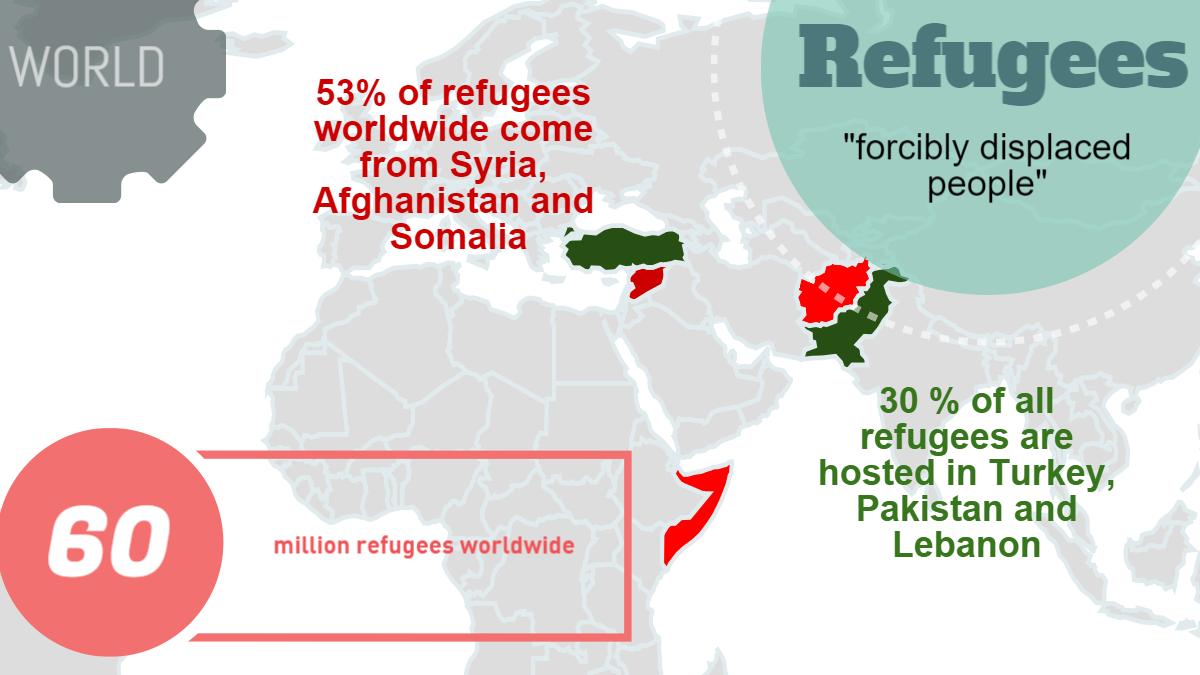
Where Turkey, Pakistan and Lebanon host the worlds largest groups of refugees, Germany is the most popular refugee destination within Europe. One third of all asylum seekers in the European Union went to Germany in 2014. The urge to be more welcoming than many other EU countries is probably partly due to the German Nazi history and experiences in the aftermath of the second world war: At the end of the second world war many ethnic Germans were part of the 40 million displaced persons within Europe.
Last year Germany welcomed more refugees than any other European country in absolute numbers. When these numbers 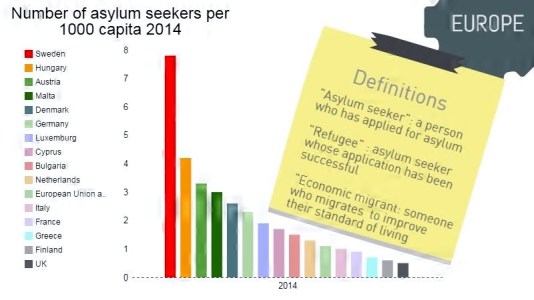 are related to the total population Sweden is the most welcoming with around 8 refugees per 1000 capita. Germany then places itself 7th with 2 refugees per
1000 capita (see infographic).
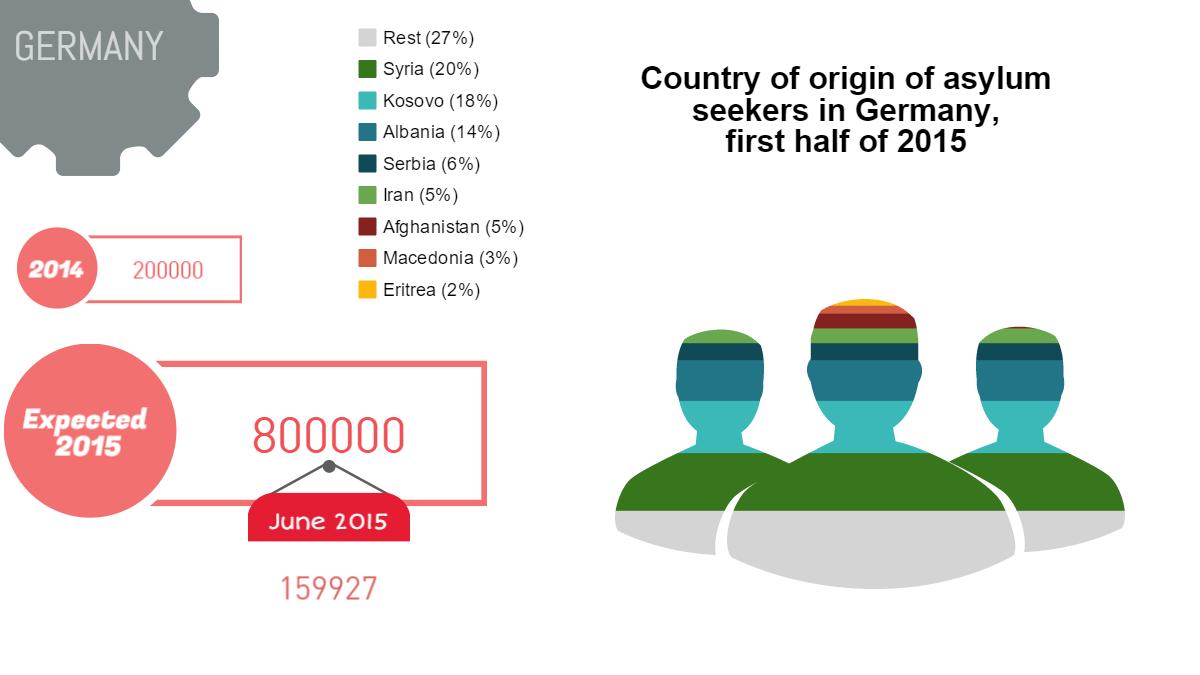
In 2014 Germany had around 200.000 asylum applications, by far the largest in Europe. The prognosis for 2015 has just been set to 800.000, more than four times the number of 2014, and 1% of the total population.
Fleeing war and persecution, Syrians account for 30% of the total number of refugees in Germany (see infographic). They are almost certain to gain the desired refugee status. Another large group are the Kosovarians whose chances of staying are slim as they are not recognised as refugees under the 1951 Refugee Convention.
The large increase in numbers is provoking two very different reactions within the population. On the one hand people are volunteering and searching for solutions to deal with so many refugees at the same time. On the other hand radical nationalistic groups are demonstrating their outrage by destroying refugee buildings – there are already 200 cases of damage through fire or with paint or water in 2015 alone. And, although neo-nazi and right-wing radical groups are active all over the world, when this show of xenophobia takes place in Germany the world and Germany itself become very alert. Interesting fact is that many of these hate crimes take place in eastern Germany whose people not so long ago also gained access to (West) Germany.
“Asylum seeker” means a person who has applied for asylum under the 1951 Refugee Convention on the Status of Refugees on the ground that if (s)he is returned to her/his country of origin (s)he has a well-founded fear of persecution on account of race, religion, nationality, political belief or membership of a particular social group
.
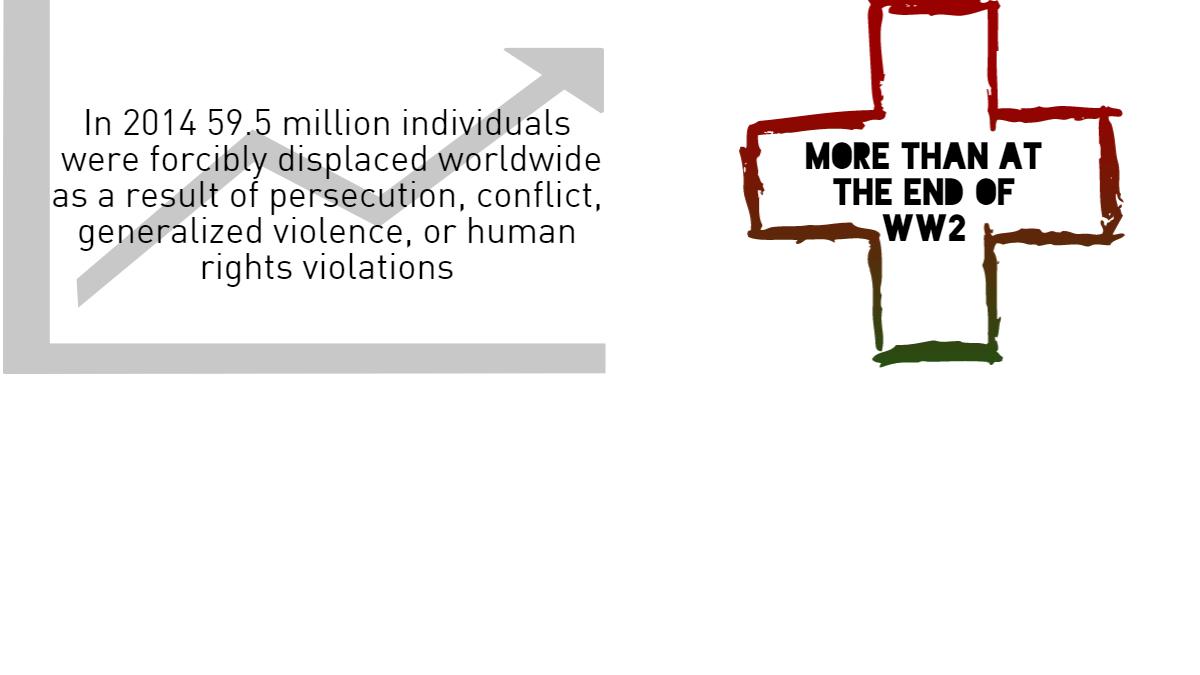
With the persecution and destruction in war torn Syria, the comparison is easily made with the European displaced person (DP) camps in 1945, which hosted a diversity of peoples. In May 1945, over 40 million people were displaced in Europe, including 13 million ethnic Germans (Volksdeutsche) who were expelled from the Soviet Union, Poland and other east European countries, known as the ‘Vertriebene’. The United Nations Relief and Rehabilitation Administration UNRRA was established in 1943, and was replaced in 1947 by the International Refugee Organization IRO. These organisations led to the establishment of UNHCR and to the adoption in 1951 of the UN Convention Relating to the Status of Refugees,
An excellent account of the DP situation in Germany from 1945 to 1949 is written by Kathryn Hulme. One of my personal heroines. Hulme worked as an electric arc welder at a shipyard in San Francisco during World War II. From 1945 onwards she spent 6 years as deputy director of UNRRA field teams and was located at DP-camp Wildflecken, 100 kilometres to the east from Frankfurt. One of my next blog posts will be about her experiences.
Information sources: from the Global Trends Study by the UN’s refugee agency UNHCR, Eurostat, CBS, BAMF (Das Bundesamt für Migration und Flüchtlinge), Zeit and Spiegel.

 mogromo
I enjoyed reading your post and I’m impressed that you made your own info graphics. Last year I did a series of posts on asylum seekers in Australia and our inhumane treatment of them.
I look forward to reading your next post.
PS there is a small typo in the 1st info graphic.
LikeLike
Thank you for reading the post and liking it. Lets hope both Europe and Australia are going to deal with the problem in a more humane manner. I hope you are having a wonderful time in Trondheim. I was in Tromso two years ago for a week and enjoyed it immensely.
P.S. Thanks for pointing out the typo.
LikeLike
I’ve heard that Tromso is spectacular! I chatted with a GP in Trondheim who lamented how boring the landscape is. I was a little shocked until he explained that he’s from Tromso.
Australia makes a huge deal about asylum seekers but receives very few!
There was a good article about asylum seekers flooding into Europe in The Economist last month. Did you read that?
LikeLike
No, I did not read the economist artikel yet, will look it up. Thanks for pointing me that way. Tromso really is fabulous., do go there when you have the chance. And I heard that the Lofoten are absolutely spectacular. I look forward to your next posts. I just posted mine.
LikeLike
As travelers and filmmakers with friends and family in Germany, this is absolutely fascinating to us. We noted with concern the rising of some right wing xenophobe groups in Hungary while there and in Germany last year, and of course it happens in the U.S. too (an anti-immigrant xenophobe currently leads the conservative polls for President here). These things must always be watched- it seems sadly that they never die. Will be looking forward to your post about Hulme!
LikeLike
I Thanks for leaving a comment! Great that the information was so interesting to you. And you are right – sadly it seems that xenophobia – usually driven by fear – is an inherent part of being human and often rears its ugly head. And I do believe the people in the USA really do not deserve the anti-immigrant xenophobe currently running for office. Great that you are looking forward to the post about Kathryn Hulme.
LikeLike
Wow, you really did your homework! Incredibly well done. I am looking forward to your post on Kathryn Hulme.
LikeLike
Thank you for the feedback! It is immensely pleasing to know someone is enjoying the posts so much. And even looking forward to a next post…
LikeLiked by 1 person