

Frankfurt – as does the whole of Germany – carries a heavy historical load. There were 26.000 Jews living in Frankfurt in 1933, the second largest Jewish population in Germany, playing leading rolls in the financial, cultural and scientific worlds of Frankfurt. Hitler’s National Socialists wreaked havoc on their lives from the start of the Nazi dictatorship in 1933 up to 1945. In the first six years Jews were totally undermined economically and forbidden to partake in public life, be it at the university, the hospitals or in politics. Many fled to other European countries, the USA or Israel. Kristallnacht on 9/10 November 1938 heralded the sharp increase of violence with the destruction and burning of Jewish property and synagogues. Deportations to concentration camps intensified substantially upto a total of at least 12.000 people. In 1945 there were 160 Jews left in Frankfurt. Nowadays there is once again a thriving community of 7000.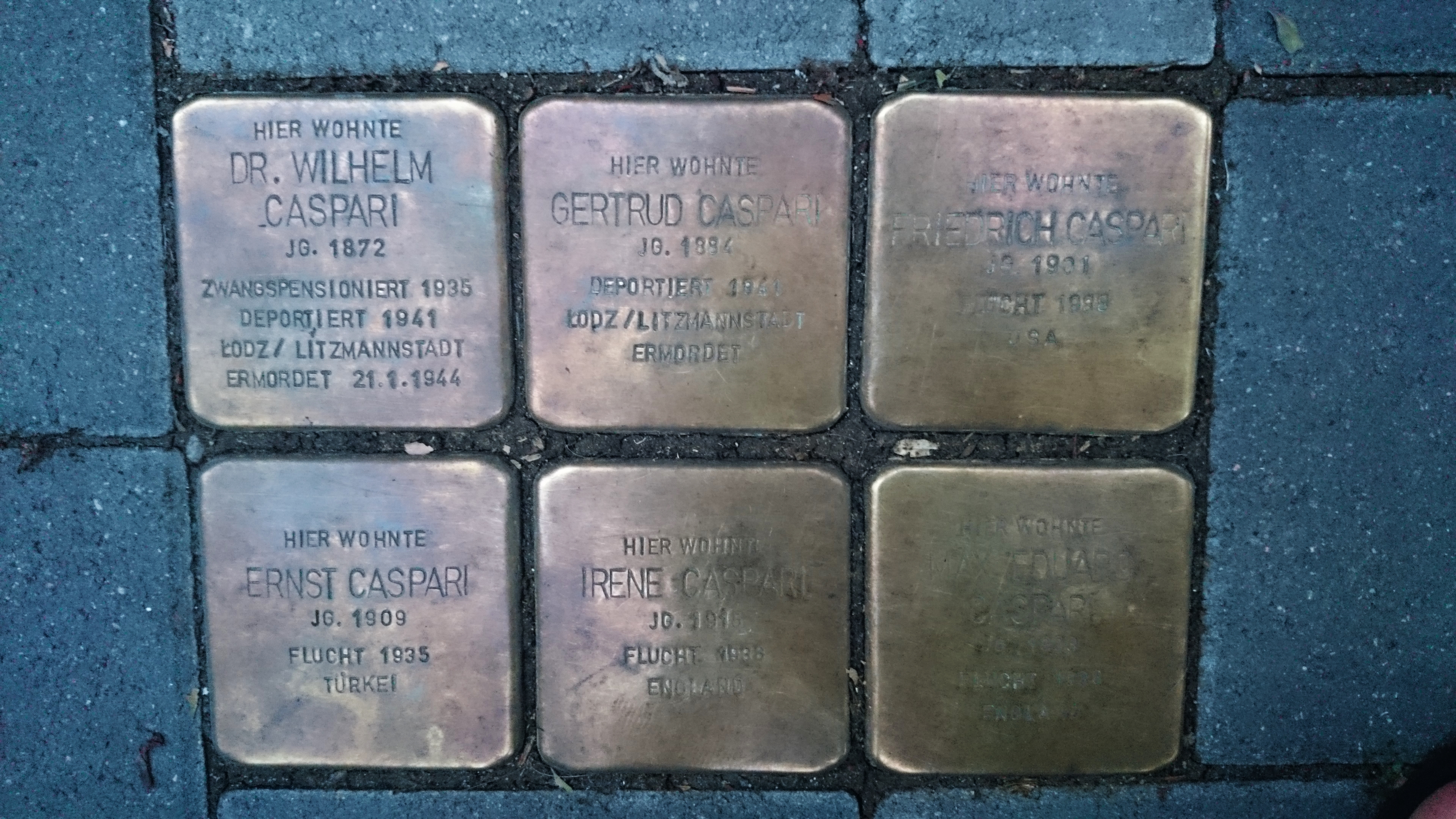
Walking along the streets in Frankfurt you literally stumble over this destructive history of wounds and shadows. The Stolpersteinen – stumbling stones – are pavement stones which have a brass plate attached to them with the name, date of birth, some historical facts (if known) and whether the person was murdered or fled. A thousand of these stones hav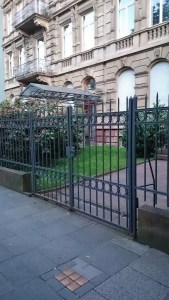 e been placed in the pavement in front of the location where the people lived. Additional stones are placed every year during the Jewish culture week. The whereabouts of the stones can be found in the following list. This map also shows the location of the stones.
A very reverent way to remember the victims of the Nazi’s, achieved through the communal effort of various Jewish and non-Jewish institutions. A total of about 50.000 stones have already been laid, mainly in Germany, but also elsewhere. An interesting fact is that the Munich city council has once again decided against placing Stolpersteinen as some Jewish institutions in that city find it a disrespectful way of honouring the dead.
A short list of other things of interest regarding this era in Frankfurt:
- The Westend Synagogue is an imposing building on the Freiherr-vom-Stein-Straße. The only Frankfurter synagogue to survive the Kristallnacht. It seems that the firefighters made an exception and intervened so as to prevent the fire from reaching the surrounding buildings.
- The headstones in the old J
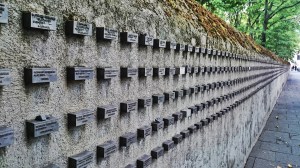 ewish cemetery on the Battonstrasse were desecrated by the Nazis in 1942.It is now a sanctuary where the stones have been assembled in various clusters. In the walls surrounding this same cemetery there are now nearly 12.000 steel blocks with the names, date of birth and death and place of deportation. Anne (Annelies) Frank also has a stone as she was born in Frankfurt in 1929 and fled to Amsterdam in 1933 where she was later deported.
 - Gisele Freund – a photographer and student activist – fled to Paris in 1933 and ended up in the Paris crowd with Adrienne Monnier and Sylvia Beach. She studied sociology at the Frankfurt University and made an interesting series of photos of the 1st of May Frankfurt anti-fascist march in 1932.
- ‘Among us’, an interesting project to raise awareness and in memory of the victims of Katzbach. This concentration camp at the A
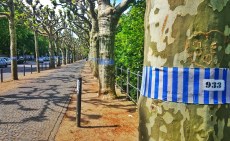 dlerwerken in Frankfurt am Main was unknown to many. Nearly all 1600 prisoners were killed including survivors from the Warsaw uprising. Bands with the infamous blue and white stripes of the concentration camps, marked with the prisoner numbers and if known the names, are tied around trees within the inner city. In july 2015 a large number of these bands were cut off on purpose in what was probably a politically driven act. A passerby who saw the destruction tweeted about it and more than 500 people come over the next few days to restore what was broken. The artist herself wrote about it here and the Frunkfurter Rundschau here
 - On Lindenstrass
 e 27 is the former Headquarters of the Gestapo which now
houses a Bank.
- The cellars of the Grossmarkthalle in Ostend was used as an assembling poin
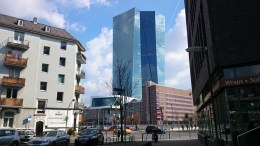 t for the Jews before they were deported to the concentration camps. The ECB tower is built on the site and rises out of the old structure which is partly still in place. The cellars have been kept intact as a memorial to the dark past.
 - Interesting literature about this period in Frankfurt: ‘Nach der Kristallnacht’ Jüdisches Leben und antijüdische Politik in Frankfurt am Main 1938-1945. Monica Kingreen.(1999).

 mogromo
Congratulations!
I have nominated your blog for the Creative Blogger Award.
That is a new award for me, and maybe for you too.
More about this nomination is at
https://dearkitty1.wordpress.com/2015/07/31/creative-blogger-award-thank-you-prasna/
LikeLiked by 1 person
Really informative. I did not learn much when I lived there as a child–probably b/c I WAS a kid and because not enough time had passed to make it comfortable enough for people to talk. I do remember the Judenfriedhof. I feel kind of weepy. Not sure how much of it is missing Fkft, thinking about the atrocities, or the connection to Hanna and Niko…great post!
LikeLiked by 1 person
Thanks, i’m glad you thought it interesting. It is an integral part of the local history and it is interesting how the victims are commemorated with creative projects so that the awareness to the dangers of hate is kept alive.
LikeLiked by 1 person
This is fascinating – especially the the part about the stumbling stones being placed near the victims’ homes. I didn’t know about this and now I really want to see Frankfurt and work through the list – which I’m going to click on now!
Thank you for writing such in interesting piece.
LikeLiked by 1 person
I am very happy you found it interesting . Sadly enough this is a part of the history but they are doing a good and important job to get the information out there. I just updated the blog with the following (which shows how important it is): In the blog I also wrote about the project ‘Among us’, Bands with the infamous blue and white stripes of the concentration camps, marked with the prisoner numbers and if known the names, are tied around trees within the inner city as a memorial to the victims of the Adlerwerken in Frankfurt. a few days ago a large number of these bands were cut off on purpose in what was probably a politically driven act. A passerby who saw the destruction tweeted about it and more than 500 people come over the next few days to restore what was broken. The artist herself wrote about it (http://www.mittenunteruns.de/zerstoerung-von-stoffbinden/) and the Frunkfurter Rundschau (http://www.fr-online.de/…/gedenkbinden-twitterer…)
LikeLiked by 1 person
It’s so sad that people can act in such a way – and distressing to surviving families. I’ve been thinking about your post for hours now and am going to reblog as it’s so thought provoking (that is, if it works for me – not tried reblogging before).
Thank you again for your post.
Ruth
LikeLike